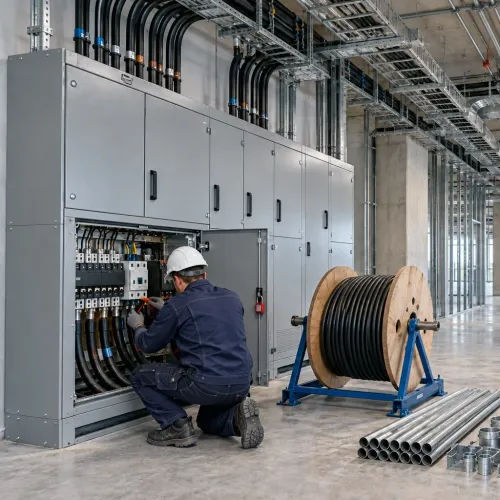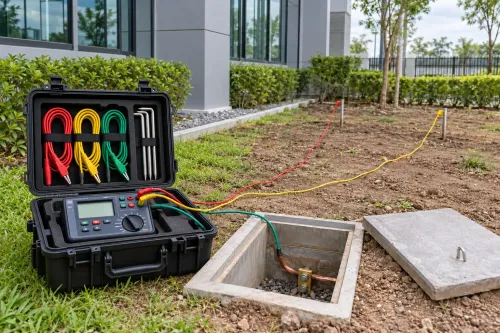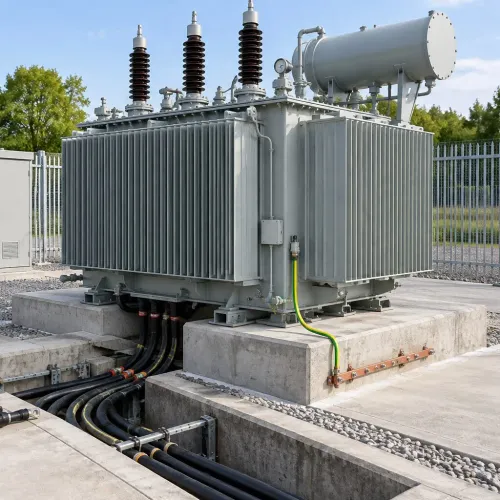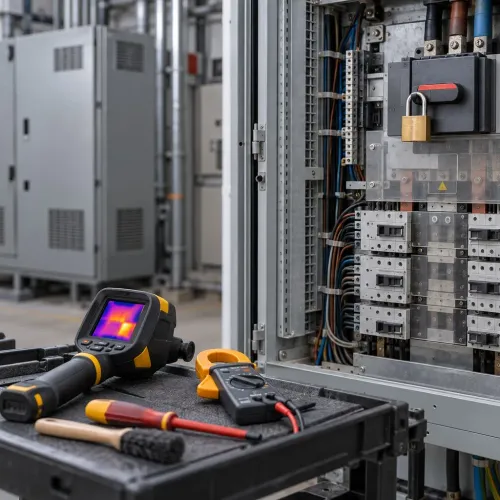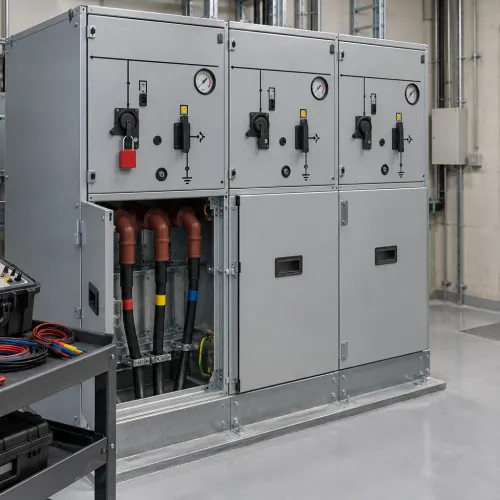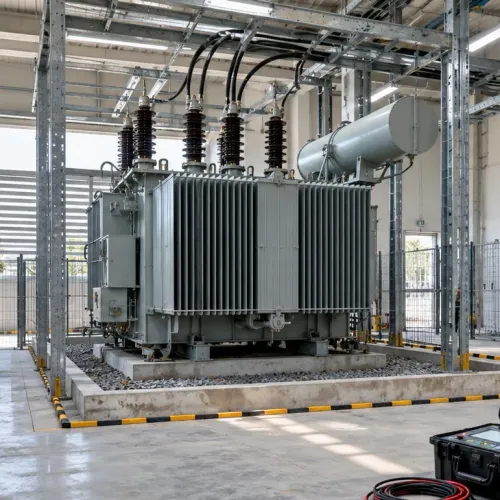
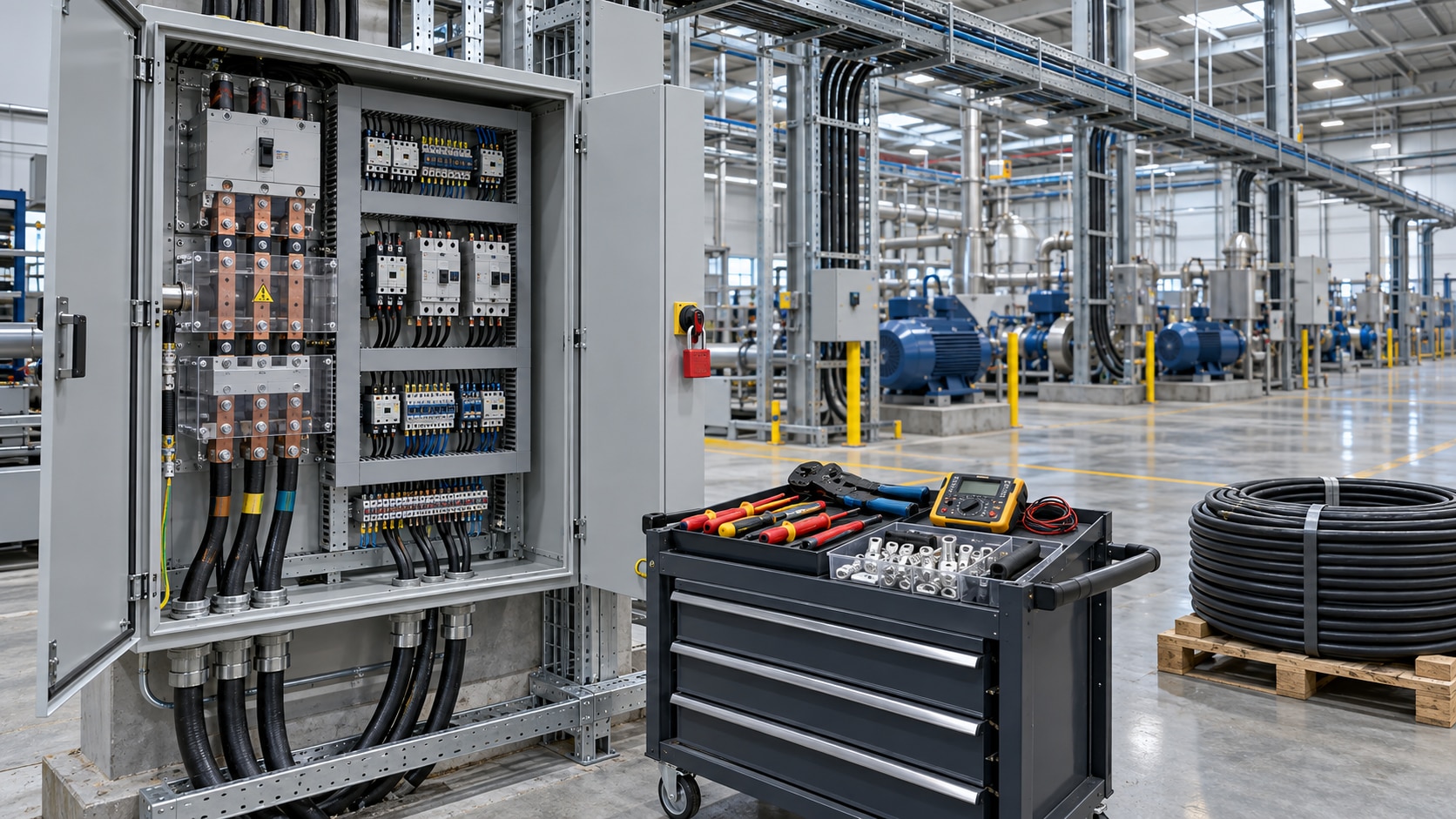
The wrong contractor can leave you with an invalid licence, undocumented protection settings, delayed energisation and maintenance costs that exceed the original quote. Use the checklist below to verify credentials, compare delivery models, test technical competence and assign every approval and handover duty before you issue an RFQ.
Key takeaways
- Verify the Class 1 licence, voltage scope and issuing authority.
- Use design-and-build contracts when coordination risk crosses multiple systems.
- Demand method statements, test records and energisation acceptance criteria.
- Specify Karnataka approvals, standards and complete handover documents in the tender.
Screen the Contractor Before You Issue an RFQ
Do not accept a licence number or project brochure as proof of competence. Verify the Class 1 electrical contractor licence with the issuing authority, then check its licence validity, permitted voltage level and scope against your proposed installation. A licence covering low-voltage work does not qualify a contractor for medium-voltage switching, protection or transformer commissioning.
1. Confirm the contractor’s experience with your facility’s voltage level, transformer capacity, sanctioned load, prospective fault level and operating environment. Ask for a completed-project list and contact two comparable clients.
2. Request single-line diagrams, protection-coordination studies, test reports, energisation records and defect-closure logs from similar projects. Check whether reports show primary-current injection, secondary-injection relay testing, breaker timing, insulation resistance and transformer tests.
3. Ask which test instruments they own, each instrument’s calibration interval, and where contractor testing ends and an independent test agency begins. Missing calibration certificates or vague responsibility for acceptance testing is a disqualifier.
4. For classified hazardous locations, match experience to the actual class, division or zone, gas or dust group, temperature classification, sealing method and inspection requirements. General “industrial” experience proves little if the protection method differs.
Review the contractor’s lockout/tagout procedure with your operations team. It must identify every energy source, including UPS systems, generators, capacitors, control circuits and automatic-transfer equipment, then cover isolation, stored-energy release, absence-of-voltage testing, group work and shift changes. Also request an asset register, maintenance frequencies and escalation criteria for post-handover service.
Match the Contract Model to Your Coordination Risk
Choose the contract model that removes your biggest interface risk, not the one with the lowest quoted fee. Give design responsibility to a single party when loads, protection, equipment layouts or operating requirements are still changing; keep it with your consultant only when the design is complete, coordinated and buildable.
| Option | What it means | When it applies |
|---|---|---|
| Design-build | One contractor designs and installs the electrical system, with one point of responsibility for design errors and construction changes. | Use for new facilities or fast-track work where the performance brief is clear but drawings are incomplete. |
| EPC contractor | The EPC contractor engineers, procures, constructs and hands over a defined electrical package, usually against performance, testing and completion obligations. | Use for substations, generating plants or major distribution upgrades where procurement and energisation interfaces need one accountable party. |
| Electrical-only contractor | Installs, tests and commissions electrical work from an approved design while you or another consultant controls design responsibility. | Use when HVAC, fire protection, controls and civil interfaces are already designed and actively managed. |
| Multi-trade contractor | Coordinates electrical work with HVAC, plumbing, fire systems, controls, civil works and commissioning. | Use when simultaneous trades create high multi-trade coordination risk, especially in occupied commercial or industrial facilities. |
Do not appoint an electrical-only contractor merely because its price is lower. Select it only after naming every interface owner, drawing the battery limits, and assigning responsibility for clashes, design revisions, shutdowns and failed tests. For a multi-trade appointment, require one integrated programme and a single interface register; otherwise coordination remains your problem.
Include measurable deliverables for drawings, test records, defect closure and handover.
Test Technical Capability, Safety Systems and Acceptance Readiness
Do not accept an arc-flash label as proof of current engineering. Demand an IEEE 1584 arc-flash study based on utility fault-current data, transformer impedances, conductor lengths and sizes, protective-device settings, equipment construction and every operating mode. The contractor must explain how changes will trigger a study update.
Ask for these records before award:
- A design calculation showing the sanctioned load, transformer capacity, fault level, voltage drop and prospective short-circuit current at each major board.
- Separate short-circuit, protective-device coordination and arc-flash reports, with stated protection objectives; maximum selectivity can conflict with faster arc-energy reduction.
- A NETA ATS-aligned acceptance-test plan covering insulation resistance, transformer tests, breaker timing, primary-current injection and secondary-injection relay testing.
- Sample signed test reports, instrument serial numbers, calibration dates, defect-disposition records and energisation checklists. Confirm which tests the contractor performs and where an independent test agency is required.
Evaluate safety in the field, not from a policy file. Observe a lockout/tagout briefing and require procedures for group work, shift changes, permits, periodic inspections and training. The isolation method must identify generators, UPS units, capacitors, control circuits, automatic-transfer equipment and backfeeds, release stored energy, and verify absence of voltage with an adequately rated instrument.
For maintainability, require final single-line diagrams, protection settings, equipment test baselines, updated labels, maintenance intervals and closed defect logs. A contractor ready to energise can show who signs each hold point and what evidence permits the next step.
Put Standards, Approvals and Karnataka Responsibilities in the Tender
Lawful energisation in Karnataka requires more than a completion certificate. Make the RFQ identify the design code, submission package, signatory, fee payer and approval milestone for every electrical system.
| Tender item | Contractor must provide | Buyer must confirm |
|---|---|---|
| Design basis | Load schedule, fault-level study, protection settings, single-line diagrams and cable calculations to IS 732, IS 3043 and IS 1646; use IEC 60364 where specified | Sanctioned load, transformer capacity, voltage, fault level and operating conditions |
| Statutory approval | Applications, drawings, test reports and inspection coordination with the Karnataka Electrical Inspectorate, plus utility documents for BESCOM or the applicable ESCOM | Who signs applications, pays fees and receives the written approval or energisation permission |
| Completion file | Insulation, earth-resistance, relay, transformer, cable, RCD and functional test results; as-built drawings and defect-closure records | No energisation before approved tests, closed defects and released drawings |
| Special locations | Classification, gas or dust group, temperature class, protection method, seals and inspection schedule for hazardous areas | Equipment approval matches the actual zone or division, not just the product category |
Put these duties in the pricing schedule:
- Obtain current statutory forms and confirm the Electrical Inspectorate’s submission requirements before construction.
- Coordinate utility shutdowns, meter release, synchronisation or parallel-operation permissions where applicable.
- State the exact energisation sequence, responsible person and hold points.
- Submit certificates, calibration records, approval letters and red-line drawings in a named digital folder.
When comparing a bidder such as Navyashree Engineers Private Limited, verify that its proposed responsible person and licence scope match the voltage and installation work, rather than accepting “Class 1” as proof by itself.
Related products
 | Industrial Electrical Contractor Industrial Electrical Contractor Navyashree Engineers regards quality as its lifeline, customer’s demand as its motivation, innovation and transformation as part of the development... View product → |
 | Electrical Design Consultants Navyashree Engineers provides high quality electrical system design & engineering capability, electrical project consultancy and construction... View product → |
Compare Total Ownership Cost and Demand a Usable Handover
Compare bids on a five-year ownership sheet, not on installed price alone. Add spares, warranty response, planned outages, training, software or relay access, obsolescence support and the labour needed for preventive maintenance before ranking the totals.
| Bid item | Low-price warning | Fair comparison |
|---|---|---|
| Installed equipment | Proprietary breakers, relays or controls | Confirm equivalent ratings, availability and approved alternatives |
| Testing and commissioning | Completion certificate only | Require NETA ATS procedures, calibrated-instrument records and signed results |
| Maintenance | “Routine service” without scope | Price frequencies, task instructions, condition findings and escalation criteria under NFPA 70B |
| Support | Short warranty with slow response | Compare response times, spare holdings, firmware access and outage requirements |
Make the selected contractor price the handover, not promise it. Require these records in searchable, editable formats:
- Updated single-line diagrams, cable schedules, panel schedules and protective-device settings
- Relay files, firmware or configuration backups, test reports, defect-closure logs and energisation records
- Equipment serial numbers, warranties, manufacturer manuals, hazardous-area records and recommended spares
- A structured CMMS asset register containing tag, location, rating, manufacturer, model, serial number, criticality, maintenance frequency and task instruction
Witness isolation demonstrations before acceptance. The contractor must show how lockout/tagout integrates with your permits, group work, shift changes and restoration checks.
Withhold final payment until documents import into the CMMS, defects close, operators receive training and baseline test data is accepted. A neat folder that cannot guide the next isolation or maintenance task is not a usable handover.
Frequently asked questions
How do you screen an industrial electrical contractor before issuing an RFQ?
Verify the Class 1 electrical contractor licence with the issuing authority, including validity, permitted voltage level and installation scope. Check comparable project references, named supervisors, testing equipment, safety records and evidence of completed commissioning.
Which contract model suits a facility with high coordination risk?
Use a model that assigns clear responsibility for design interfaces, procurement, installation, testing and commissioning. Design-and-build reduces coordination gaps when electrical, HVAC, controls and facility systems must work together, while separate packages require a strong client-side coordination function.
What technical and safety evidence should an electrical contractor provide?
Request project-specific method statements, single-line diagrams, protection settings, inspection and test plans, calibrated instrument certificates, permit-to-work procedures, isolation controls, emergency arrangements and defined acceptance tests before energisation.
What standards and Karnataka approvals belong in the tender?
Name the required standards and submissions, including applicable IS standards, the Central Electricity Authority safety regulations, BESCOM or the relevant electricity supply company requirements, and Electrical Inspectorate approvals for installations that require inspection before energisation.
What should you compare when evaluating total ownership cost?
Compare capital cost with energy losses, maintenance access, spare parts, warranty coverage, response times, replacement intervals, testing requirements and downtime exposure. Require as-built drawings, asset registers, test certificates, warranties, operation manuals and training at handover.
Related products
 | Electrical Contractors Navyashree Engineers is a well-known leading electrical contractor with extensive knowledge in all realms of electrical works. View product → |
 | Licensed Class 1 Electrical Contractor Licensed Class 1 Electrical Contractor Navyashree Engineers is a leading class 1 licensed electrical contractors in Bangalore. View product → |
 | HT Installation and Electrical Service HT Installation and Electrical Service Navyashree Engineers team does the installation, testing & commissioning of overhead HT/ LT transmission lines. View product → |
 | LT Installation and Electrical Service LT Installation and Electrical Service LT Installation Electrical Services is a prominent player in the field of electrical installation, specializing in low-tension (LT) electrical... View product → |