Scorch marks, repeated breaker trips, burnt-plastic odours, buzzing, corrosion and water marks are not minor cosmetic defects. You will learn how to separate routine maintenance findings from immediate hazards, what observations are safe, and when a qualified electrician must isolate, test or replace panel components.
Key takeaways
- Arrange an inspection for scorching, melted insulation, cracked breakers, or exposed conductors.
- Treat repeated trips, buzzing, heat, or burning smells as fault signals.
- Keep panels dry, enclosed, labelled, and accessible for safe operation.
- Choose repair, replacement, or scheduled maintenance based on the fault and panel condition.
Start with the panel’s visible condition
Scorching, melted insulation, cracked breakers, exposed conductors, or a cover that no longer closes are not cosmetic defects.
They show that the panel needs inspection, and a burning smell, smoke, visible arcing, water entering an energized panel, or rapidly worsening heat requires immediate isolation if you can do so safely; keep clear and call a qualified electrician.
| Visible condition | What it indicates | Action |
|---|---|---|
| Scorching or brown busbar marks | Abnormal heating, loose termination, overload, or poor contact | Isolate if hot, smoking, or worsening; otherwise arrange urgent inspection |
| Melted insulation or cracked breakers | Damaged insulation or a failed protective device | Isolate the affected circuit and obtain qualified repair |
| Corrosion and rusting inside electrical panels | Moisture has reduced connection and insulation reliability | Stop treating it as surface dirt; find the moisture source and inspect |
| Water marks, mineral deposits, or condensation | Water has reached the enclosure or its components | Isolate before opening; test and replace damaged parts |
| Dust, loose covers, or damaged cable glands | Contamination, lost enclosure protection, or cable strain | Schedule maintenance; do not restart after cleaning alone |
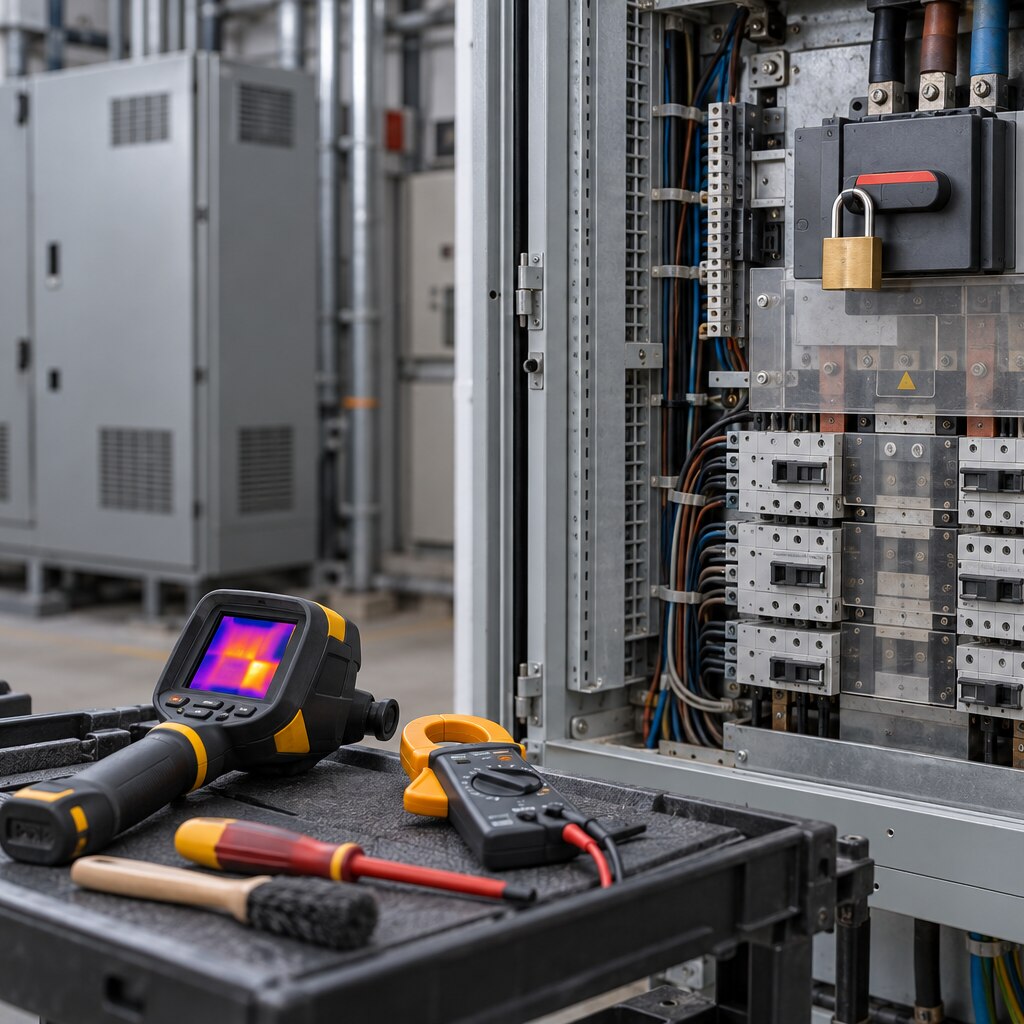
Do not touch a discoloured breaker, busbar, or conductor to judge temperature, and do not remove the dead front. Infrared scanning can locate an energized hot spot, but it cannot reveal every loose connection, damaged insulation, incorrect breaker, or defect hidden behind the cover.
A qualified electrician must de-energize, inspect, test, and document the panel before returning it to service.
Treat abnormal breaker behaviour as a fault signal
Repeated breaker tripping is a diagnostic signal, not permission to keep resetting the switch. It can indicate sustained overload, a short circuit, a ground fault, a failing breaker or a fault in connected equipment; repeated resetting increases exposure to arc-flash and fault energy.
The fault could involve:
- A circuit carrying more load than its conductors or breaker rating allows
- Damaged insulation, a shorted appliance or a ground-fault path
- A loose termination, poor contact pressure or an overheated connection
- A breaker that has lost its mechanical or thermal performance
- Downstream equipment that fails whenever it starts or reaches operating temperature
Nuisance tripping means the breaker opens without an obvious overload, often intermittently. Do not replace it with a larger breaker or hold it closed; record what was operating and have a qualified electrician test the circuit and device.
A hot circuit breaker, discolouration or a burning smell indicates abnormal heating, not a harmless warm panel. Loose or improperly torqued terminals, overload, conductor damage and incompatible components require inspection, and infrared scanning alone cannot reveal every defect behind the dead front.
If the breaker will not reset, leave it off. A persistent fault or damaged mechanism may be present. If a protective device fails to trip when its test button is pressed, its protection cannot be trusted; isolate the circuit and arrange qualified testing before re-energising it.
Use heat, sound and smell to identify escalation signs
An energized panel can have an evenly warm outer door under normal load. Do not place your hand inside or on exposed metal to judge temperature; look for a localized hot area, fresh discoloration, softened plastic or smoke, and ask a qualified electrician to confirm suspected panel overheating with a thermal camera.
Escalate immediately if you observe any of these signs:
- A breaker, bus connection or cable termination is visibly darker, blistered, melted or surrounded by soot.
- A buzzing electrical panel produces a new, loud or uneven hum that changes when equipment starts.
- Crackling and popping sounds indicate arcing, especially when paired with flickering lights or visible flashes.
- An acrid burnt-plastic smell persists near the door, cable entries or ventilation openings.
- Smoke, carbon tracking or a glowing point appears anywhere on the enclosure.
A normal warm enclosure has no burning odour, smoke, soot, arcing marks or harsh noise. A hot spot does not identify the cause: loose or incorrectly torqued terminals, overload, damaged conductors, poor contact pressure and incompatible components all require testing.
Move people away, keep the door closed and arrange isolation by qualified personnel when you see smoke, smell burning, hear crackling or find melted insulation. Do not remove the cover, spray the panel or keep resetting breakers; an apparently minor fault can expose live parts or ignite surrounding material.
Check moisture, enclosure damage and unsafe access
Cleaning is enough only when the enclosure is dry, intact, and a qualified electrician finds no contamination or heat damage. Water ingress in electrical panel enclosures demands more: identify and stop the leak, isolate the circuit, and inspect de-energized equipment before re-energizing. Floodwater can leave conductive residue that cleaning alone will not remove.
Treat these findings as escalation triggers:
- Condensation and mineral deposits inside the cabinet: test insulation and connections after correcting the moisture source; replace corroded terminals, busbars, breakers, or wiring that no longer meets its condition requirements.
- Rust, tide marks, swollen insulation, or water below the panel: do not clean and restart. Arrange a de-energized inspection and replace water-damaged parts.
- Damaged cable glands, split seals, or gaps around entries: replace them with correctly sized glands and restore the enclosure’s environmental protection.
- A missing dead front and open knockouts: isolate the panel until listed, panel-compatible covers and fillers are fitted. Improvised metal or plastic blanks are not equivalent.
- A blocked working space: remove stored materials before service. Use 30 inches of width, 36 inches of depth, and 6 feet 6 inches of headroom as a common NEC benchmark for equipment up to 600 volts.
Infrared scanning can locate energized hot spots, but it cannot prove that moisture has not damaged insulation or connections behind the dead front. If water reached live parts, require qualified testing before energizing; replace components that fail insulation, mechanical, or functional checks.
Decide whether the panel needs repair, replacement or a maintenance program
Choose repair for a defined, replaceable defect; choose replacement when the equipment is unsafe, incompatible or inadequately rated; choose a maintenance program when the panel remains suitable but lacks reliable inspection and service records.
| Action | Evidence | Required checks |
|---|---|---|
| Repair | A loose connection, damaged lug, failed breaker or localized corrosion has a clear remedy | De-energize where required, inspect conductors, and restore terminal torque to the manufacturer’s specification with a calibrated tool |
| Replace | The enclosure, bus, insulation or breaker system is damaged, obsolete or incompatible | Confirm breaker compatibility, panel capacity, breaker interrupting rating and available fault current rating |
| Maintenance program | The panel is serviceable, but records, cleaning, testing or scheduled torque checks are missing | Set inspection intervals, record readings and track recurring trips, thermal findings and repairs |
An infrared electrical panel inspection can locate energized hot spots, but it cannot reveal every loose connection, damaged insulation, incorrect breaker type or defect hidden behind the dead front. Treat a hot termination as a lead, not a diagnosis; follow with a de-energized inspection and verify terminal torque rather than tightening everything blindly.
Age alone does not justify replacement. A 25-year-old panel with sound components, suitable ratings and complete records may remain viable, while a newer panel with water damage or unavailable protective devices may not.
Navyashree Engineers Private Limited can help compare the as-built panel, service changes and maintenance records before you approve a replacement instead of a targeted repair.
Related products
 | LT Installation and Electrical Service LT Installation and Electrical Service LT Installation Electrical Services is a prominent player in the field of electrical installation, specializing in low-tension (LT) electrical... View product → |
 | Commercial Electrical Contractors Commercial Electrical Contractors Navyashree Engineers, is a professionally managed class 1 Electrical contractors in South india. View product → |
Frequently asked questions
Which visible defects indicate that an electrical panel needs maintenance?
Scorching, melted insulation, cracked breakers, exposed conductors, and a cover that no longer closes require attention.
What breaker behaviour signals a possible electrical fault?
Repeated tripping or abnormal breaker operation signals a fault that needs investigation rather than repeated resetting.
Which heat, sound, and smell warning signs require escalation?
Unusual heat, buzzing or crackling, and burning smells indicate escalating panel problems that need prompt professional inspection.
When should you repair or replace an electrical panel?
Repair the specific fault when the panel remains serviceable; consider replacement when damage affects the enclosure, breakers, insulation, or safe operation.
Related products
 | Licensed Class 1 Electrical Contractor Licensed Class 1 Electrical Contractor Navyashree Engineers is a leading class 1 licensed electrical contractors in Bangalore. View product → |
 | HT Installation and Electrical Service HT Installation and Electrical Service Navyashree Engineers team does the installation, testing & commissioning of overhead HT/ LT transmission lines. View product → |
 | Facility Management Services Navyashree Engineers. provides Facility Management Services to a large number of Corporates backed by Skilled & Technical manpower. View product → |
 | Industrial Electrical Contractor Industrial Electrical Contractor Navyashree Engineers regards quality as its lifeline, customer’s demand as its motivation, innovation and transformation as part of the development... View product → |