A panel can look complete, pass an insulation-resistance test and still contain incorrect protection settings, loose terminations, a failed interlock or an unsafe short-circuit rating. By the end, you will be able to distinguish testing from commissioning, identify the checks required before energisation, and judge whether the handover records prove that the panel is ready for service.
Key takeaways
- Test insulation, continuity, earthing and connections before energising.
- Prove breaker trips, interlocks, controls and transfer sequences under operating conditions.
- Record protection settings, test instruments, results and corrective actions.
- Use a commissioning specialist when faults, interfaces or critical loads raise risk.
Testing finds defects; commissioning proves the panel can operate safely
Electrical panel testing answers a narrow question: are the panel, conductors, connections and protective devices free from measurable defects? Electrical panel commissioning answers the larger question: can the complete installation operate safely under its intended control and fault conditions?
| Activity | Main question | Typical scope |
|---|---|---|
| Electrical panel testing | Is each component electrically and mechanically sound? | De-energised testing, insulation resistance, continuity, earth-conductor checks, phase sequence, torque verification and breaker trip tests |
| Electrical panel commissioning | Does the installed system perform its design function safely? | Document review, functional sequences, interlocks, protection settings, controlled energisation, operating checks and close-out records |
ANSI/NETA ATS provides a recognised framework for acceptance testing electrical power equipment and systems before energisation. It supports testing, but commissioning also checks whether the installed panel matches the approved drawings, equipment ratings, control logic and coordination study.
The distinction matters because a panel can pass an insulation-resistance test yet fail when an automatic transfer scheme operates, a remote permissive is absent, or two sources are interlocked incorrectly. De-energised testing cannot prove every live operating sequence, while energisation without completed testing exposes people and equipment to preventable fault energy.
A defensible commissioning process therefore verifies protective-device pickup and timing, confirms mechanical and electrical interlocks, controls backfeed and stored energy, and records the result. The handover then shows not merely that tests were performed, but that the panel can perform its intended duty safely.
What must be checked before a panel is energised
Power stays off until the paperwork, installation and dead tests agree. Review the approved single-line diagram, panel schedule, manufacturer instructions, protection settings and design ratings: nominal voltage, frequency, continuous current, short-circuit withstand or short-circuit current rating, enclosure rating, bus arrangement and upstream protective-device compatibility.
A correct nameplate alone does not prove the installed assembly can withstand the available fault current.
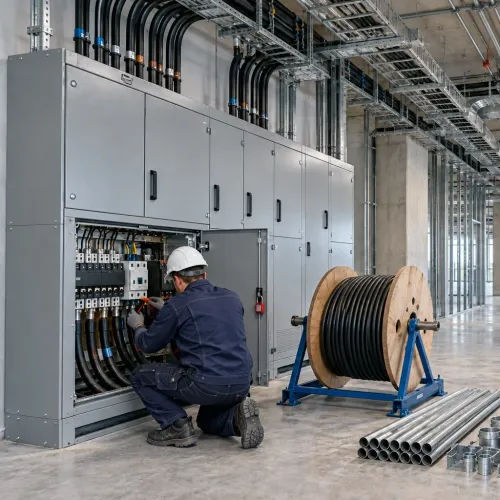
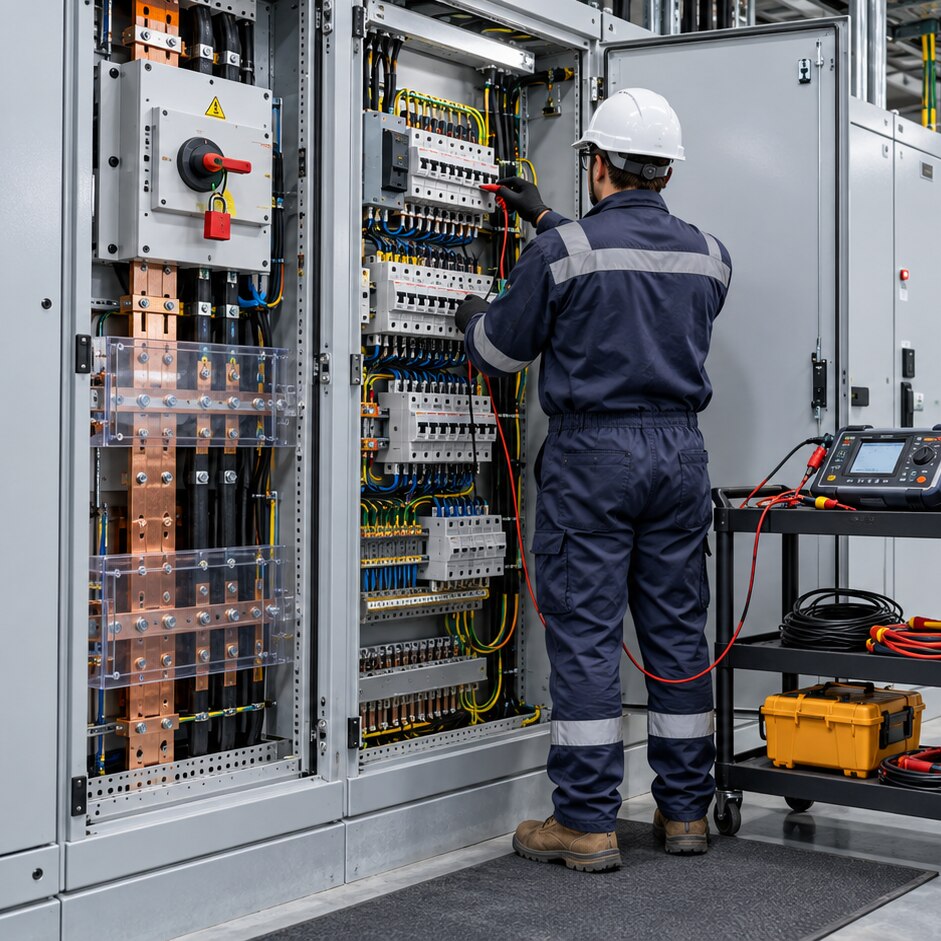
Inspect the panel against the drawings and installation requirements. Check:
- Correct equipment, barriers, covers, labels and working clearance
- Secure mounting, clean compartments, supported conductors and separation of power and control wiring
- Cable tags and gland checks, including tight, compatible glands and sealed entries
- Lug sizes, conductor identification, phase arrangement and accessible disconnects
- Torque records showing the manufacturer’s specified value, connection and tool method
Complete and record dead tests before closing the isolation boundary.
| Check | What to verify | Why it matters |
|---|---|---|
| Insulation resistance | Test each required circuit at the manufacturer’s specified voltage; isolate meters, trip units, SPDs, VFDs and other sensitive devices | Finds moisture, contamination, damaged insulation and wiring faults |
| Continuity and earth continuity | Confirm conductor paths, bonding and protective-conductor connections | An open protective path can leave exposed metal unsafe |
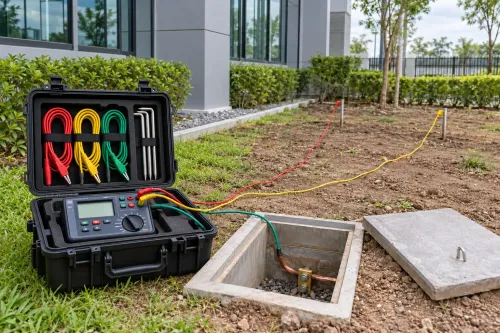
| Earth resistance | Test the earthing electrode or system where the installation design requires it | High resistance can limit fault-current clearing |
| Polarity and phase identification | Confirm terminals, neutral and protective conductors against the drawings | Reversed connections can defeat controls or create shock hazards |
| Breaker or RCD verification | Use the approved injection or test method, including RCD operation where fitted | Proves protection without relying on a visual inspection |
Record every result and correct failures before applying power.
How breakers, controls and transfer equipment are proven in operation
Controlled energisation follows an approved sequence, not a single switch-on. Qualified personnel establish approach boundaries, control backfeed and stored energy, verify the intended source, and energise control power before load circuits where the design permits.
They watch voltage, phase sequence, alarms and abnormal sound or smell at each step, stopping if any reading or indication disagrees with the drawings.
Functional checks then use the panel’s actual operating logic. Test each function under the conditions in which it must work:
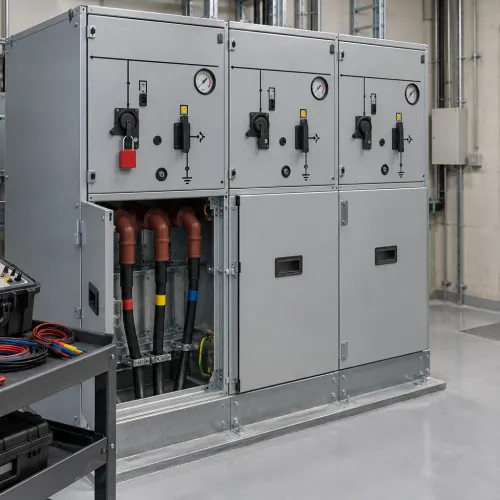
- ACB and MCCB trip testing confirms that the breaker opens at its specified pickup and time; verify trip, close, shunt-trip and undervoltage-release circuits where fitted.
- MCB operation confirms correct switching and indication, but does not prove the complete upstream protection scheme.
- Contactor and overload relay testing confirms starting, stopping, overload response, auxiliary contacts and reset behaviour.
- Automatic transfer switch testing simulates loss and return of the normal source, checks standby-source start, transfer and retransfer delays, and confirms mechanical and electrical interlocks.
Operate breakers through their permitted racking positions and test remote-control permissives, local/remote selection, alarms, status points and fail-safe responses. A point-to-point wiring pass cannot expose a sequence fault between two sources.
The commissioning team also verifies CT ratio and polarity, protective-relay wiring, phase rotation and remote trip circuits. A breaker that trips on a test instrument can still leave the real protection scheme ineffective if a CT is reversed or an interlock is bypassed.
Protection settings and records determine whether a test is defensible
A defensible fault-response test connects the approved protection setting to the device’s measured operation and the installed assembly. Compare each breaker or relay with the protection coordination and arc-flash study, then confirm the short-circuit current rating, voltage, bus arrangement and upstream device are compatible.
Correct settings support discrimination: the device nearest the fault trips first without unnecessarily disconnecting healthy circuits.
Use the injection method that matches the question being asked.
| Method | What it proves | Limitation |
|---|---|---|
| Secondary injection | Relay logic, programmed pickup, timing and trip-unit functions | Does not fully exercise the primary current path or current sensors |
| Primary injection testing | Current path, sensors, connections and complete high-current trip response | Requires more outage time, equipment and preparation |
A breaker trip result alone does not prove the protection scheme. Verify CT ratio and polarity, relay wiring, trip and close coils, shunt trips, undervoltage releases, interlocks, remote trips, alarms and zone-selective-interlocking circuits. A reversed CT or phase sequence can leave the panel apparently functional while fault protection fails.
The commissioning record makes the conclusion traceable. Preserve:
- Equipment identifiers and as-left protective settings
- Test instrument IDs, calibration status, applied currents or voltages, measured pickup and trip times
- Relevant conductor or ambient temperature
- Discrepancies, corrective actions and approved deviations
Record the method, test point and result against the approved design. ANSI/NETA ATS provides a recognised acceptance-testing framework; complete records also establish the baseline for maintenance and later fault investigation.
What a useful handover proves—and when to bring in a commissioning specialist
A handover is useful only if another engineer can reconstruct what was tested, with what instrument, and under which conditions. The commissioning report must identify each panel and device, record calibrated test equipment and calibration status, list test voltages, currents and measured values, and document discrepancies, corrections and approved deviations.
It should also include:
- As-left settings for breakers, relays and trip units, matched to the approved coordination and arc-flash studies.
- Functional results for interlocks, transfer sequences, standby sources, remote permissives and fail-safe actions.
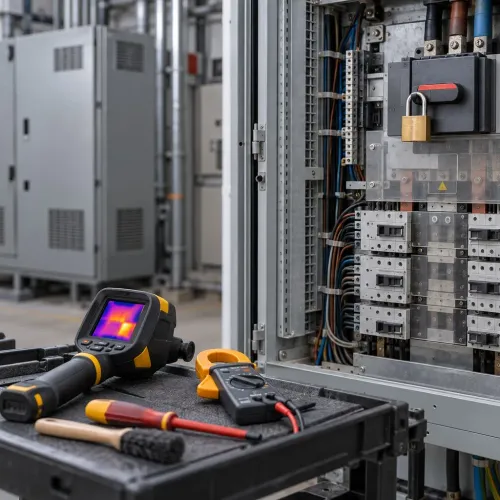
- De-energised inspection and test results, followed by energisation records and thermography under load.
- Drawings, test certificates, photographs, signatures and the date of handover.
Assess a contractor against evidence, not a generic promise of “testing and commissioning.”
| Capability | Evidence to request | Warning sign |
|---|---|---|
| Protection testing | Sample trip-test records showing pickup, timing, injection method and settings verification | Only visual checks or insulation resistance results |
| Instrumentation | Current calibration certificates and instrument serial numbers linked to reports | “Calibrated equipment” with no certificate or ID |
| Functional commissioning | A written sequence for interlocks, automatic transfer and emergency operation | Point-to-point checks presented as complete commissioning |
For a Bengaluru project, Navyashree Engineers Private Limited is worth assessing by asking whether its proposed scope names these tests, records and acceptance criteria before work begins.
Related products
 | HT Installation and Electrical Service HT Installation and Electrical Service Navyashree Engineers team does the installation, testing & commissioning of overhead HT/ LT transmission lines. View product → |
 | Commercial Electrical Contractors Commercial Electrical Contractors Navyashree Engineers, is a professionally managed class 1 Electrical contractors in South india. View product → |
Frequently asked questions
What is the difference between electrical panel testing and commissioning?
Testing measures the panel, conductors, connections and protective devices for defects. Commissioning proves the complete installation operates safely under intended controls and fault conditions.
What must be checked before an electrical panel is energised?
Check insulation resistance, continuity, earthing, phase identification, torque at connections, cable termination, enclosure condition, protective devices and absence of tools or debris.
How are breakers, controls and transfer equipment proven?
Test breaker operation and trip functions, verify control circuits and interlocks, and run automatic and manual transfer sequences under the specified operating conditions.
What records make panel commissioning defensible?
Keep approved drawings, equipment details, protection settings, instrument calibration information, test results, trip records, photographs, defects, corrective actions and final sign-off.
Related products
 | Licensed Class 1 Electrical Contractor Licensed Class 1 Electrical Contractor Navyashree Engineers is a leading class 1 licensed electrical contractors in Bangalore. View product → |
 | Electrical Design Consultants Navyashree Engineers provides high quality electrical system design & engineering capability, electrical project consultancy and construction... View product → |
 | LT Installation and Electrical Service LT Installation and Electrical Service LT Installation Electrical Services is a prominent player in the field of electrical installation, specializing in low-tension (LT) electrical... View product → |
 | Industrial Electrical Contractor Industrial Electrical Contractor Navyashree Engineers regards quality as its lifeline, customer’s demand as its motivation, innovation and transformation as part of the development... View product → |