A transformer does not need oil filtration simply because it has reached a certain age. The decision rests on laboratory evidence, operating history and the contaminant involved, so you can distinguish a routine oil-cleaning job from dehydration, reclamation, fault investigation or full oil replacement.
Key takeaways
- Filter when tests confirm free water, particles or low dielectric strength.
- Use dehydration for water, particle filters for solids and degassing for dissolved gases.
- Treat online only with stable conditions, compatible equipment and safe connections.
- Isolate the transformer before opening it, correcting leaks or addressing severe contamination.
Which test results justify transformer oil filtration?
Filtration is justified when current results show free water, suspended particles or inadequate dielectric strength. Start with a laboratory sample, especially after the transformer was opened, transported with compromised seals, exposed to humid air or topped up with oil of uncertain cleanliness. Do not use transformer age or visual clarity as a trigger.
Compare the breakdown voltage testing result comparison against IEC 60156, moisture content measured by the Karl Fischer method under IEC 60814, particle count, resistivity and tan delta with transformer manufacturer limits, IEC 60422, site maintenance history and trend data.
Sampling conditions matter: controlled comparison between laboratories and field testers must not be assumed to be equivalent unless the test method, electrode arrangement, conditioning and sample handling are controlled, because dielectric strength is influenced by those conditions.
- Free water or high moisture content supports dehydration and filtration.
- Suspended particles and a high particle count support particulate filtration.
- Low breakdown voltage, resistivity or poor tan delta supports treatment after confirming the sample was handled correctly.
| Result | What it indicates | Decision |
|---|---|---|
| High acidity or neutralisation number, low interfacial tension, high dissipation factor | Oxidation or sludge-related deterioration | Simple filtration may not correct it; assess reclamation, regeneration or replacement |
| DGA showing hydrogen, methane, ethane, ethylene, acetylene, carbon monoxide or carbon dioxide | Possible thermal or electrical fault | Interpret against trend data |
| Elevated acetylene or rapidly changing gas pattern | Possible active arcing or fault | Fault assessment and repeat sampling, not automatic filtration |
Include dissolved-gas analysis after overheating, electrical trips or unexplained gas alarms. DGA is not itself a filtration trigger.
Which oil treatment matches the contaminant?
Choose the process from the test result, not from a supplier’s use of the word filter. Contaminant matching starts with the particle count, moisture result and dissolved-gas analysis.
A conventional particulate filter addresses suspended particles and suspended solids when the equipment specification gives a filtration rating; it is the correct particle removal treatment process for confirmed solids removal and particulate contamination. A supplier equipment specification must identify filtration rating, water removal capability, vacuum performance, throughput and final oil acceptance criteria.
| Option | Removes or addresses | Use when the test shows |
|---|---|---|
| Particulate filtration | Suspended particles and suspended solids | Particle count confirms solids; use the specified filtration rating |
| Vacuum oil dehydration | Free water, dissolved water and oil moisture | Karl Fischer moisture is high; vacuum dehydration targets oil moisture removal |
| Vacuum degassing | Dissolved gases | Gas analysis requires gas removal; it does not repair arcing, overheating or insulation damage |
| Oil reclamation or regeneration | Oxidation products, polar compounds and sludge | Acid number or acidity is high, interfacial tension is low, or sludge is severe |
| Complete oil replacement | Oil that cannot meet acceptance criteria | Treatment fails, or oil compatibility and condition make reuse unsuitable |
Vacuum oil dehydration does not prove that moisture has left the paper insulation or corrected insulation moisture. A conventional particulate filter does not remove dissolved water, dissolved gases, acidity or oxidation products. Check the insulating liquids: mineral oil, natural ester or synthetic ester.
For oil reclamation, reclamation, oil regeneration, regeneration, adsorbent treatment, oxidation inhibitor or inhibitor management, follow manufacturer instructions for temperature, seals, hoses, adsorbents, reuse and oil compatibility.
When is online treatment suitable, and when is isolation required?
Online filtration suits a stable transformer when the oil processing plant matches the fluid and its connection points permit controlled circulation without exposing live electrical parts.
Use online oil treatment for a documented moisture or particle problem when the live transformer has no urgent DGA pattern, the oil level can be maintained, and manufacturer approval permits online processing.
1. Choose offline oil treatment after a transformer trip, internal inspection, oil leak, transport damage, compromised breather, or electrical fault. Elevated acetylene, an internal fault, a DGA change, or a rapidly changing gas pattern requires fault assessment, repeat sampling and an operational-risk review—not routine filtration.
2. Plan transformer isolation and isolation before work that opens the tank, removes covers or disconnects conservator components. De-energise, apply lockout, discharge, and complete earthing and grounding before handling the transformer.
3. Inspect every conservator-type transformer’s conservator, breather, silica gel, bladder or diaphragm, oil level and leakage points. Uncorrected humid air ingress will cause recontamination after treatment.
Set the outage window for isolation, hose connection, circulation, sampling, settling and return-to-service checks. Navyashree Engineers Private Limited can help coordinate this work with site permits, HT/LT controls, earthing and contractor safety procedures.
Before approving either method, request the proposed process, oil processing plant specifications, manufacturer approval and acceptance criteria, including repeat laboratory results and any required DGA follow-up. Visual clarity alone cannot release the transformer.
What happens during a controlled oil-filtration job?
A controlled oil-filtration process starts with a sealed pre-treatment sample, before connecting the filtration plant. Use a clean, dry sample container and controlled sampling procedure to prevent atmospheric contamination; record sample handling and sample identification, transformer identification, oil type, temperature, sampling point and operating condition.
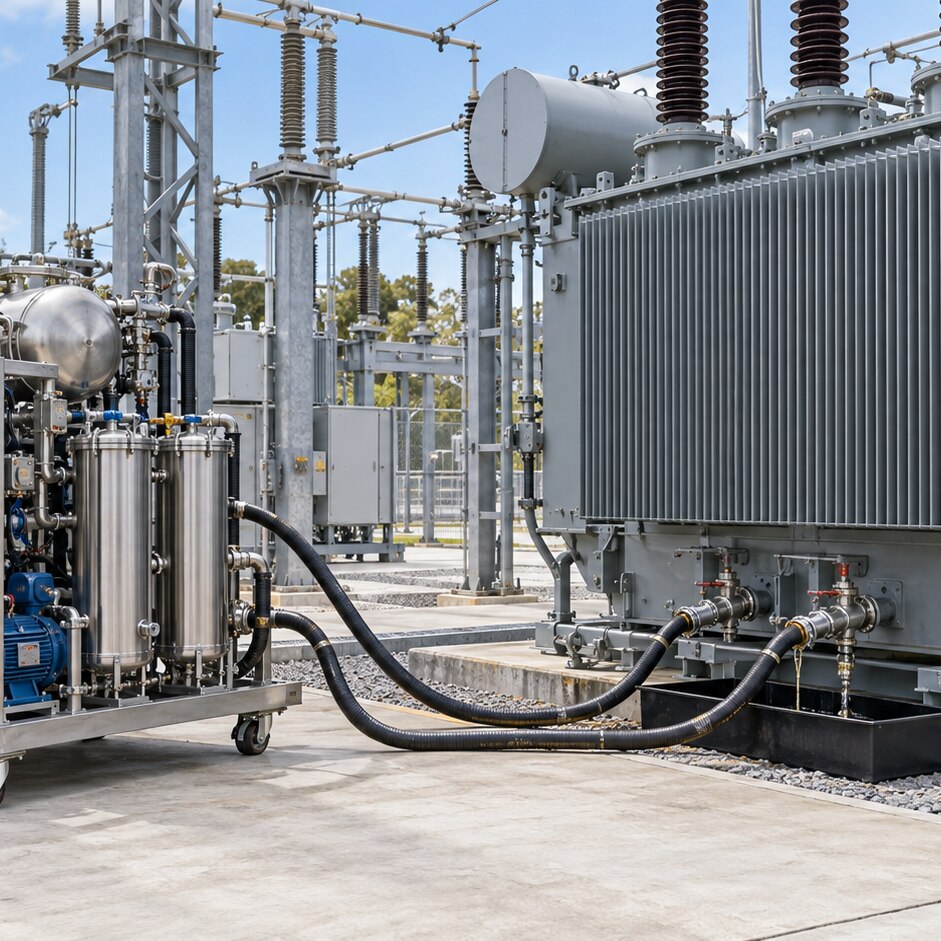
Inspect the plant’s pump, heater, vacuum chamber, filter stages, gauges and hoses. Confirm clean, dry oil-contact surfaces, compatible hoses and receiving vessels.
During oil circulation:
- Connect the plant and begin flow monitoring and temperature monitoring; heat within the oil and transformer manufacturer’s permitted range while circulating oil.
- Monitor and record flow rate, inlet temperature, outlet temperature, vacuum level, pressure drop and leak monitoring.
- Apply vacuum for vacuum dehydration or vacuum degassing; stop for excessive foaming, unstable vacuum, filter blockage or air ingress.
- Complete enough passes to meet the agreed endpoint, not a fixed number of hours.
| Treatment | Target | Control |
|---|---|---|
| Particulate filtration | Suspended solids | Specified filter stages |
| Vacuum dehydration | Water | Apply vacuum within permitted limits |
| Vacuum degassing | Dissolved gases | Verify vacuum performance |
After circulation, allow required settling, then take a post-treatment sample with the sampling procedure and clean, dry sample container. Post-treatment acceptance testing compares repeat laboratory results with pre-treatment results and final oil acceptance criteria, not visual clarity.
Documentation must include the treatment log, equipment details, flow and temperature logs, vacuum readings, filter changes, sample times, test reports and the return-to-service decision.
What safety controls protect the transformer and the oil?
Safety begins with transformer isolation and earthing, not the pump. Treat transformer oil filtration safety for a mineral oil filled transformer as electrical work and fire risk.
1. Approve the switching plan and isolation certificate; apply lockout, test for dead, and install visible earths before connecting equipment. Keep ignition sources away. Provide fire controls, fire extinguishers and ventilation. Use oil spill containment with spill trays, absorbent materials and oil recovery for hoses, filters and drained oil.
2. Use clean hoses and dry hoses; verify hose cleanliness, receiving vessel cleanliness and capped hoses, seals and couplings. An open connection invites atmospheric moisture, contamination during refilling and air ingress. Control conservator pressure, provide breather protection, and prevent pressure changes or air entering during pumping, refilling and sampling.
For ester fluids and other insulating liquids, follow manufacturer instructions, material compatibility and temperature limits; do not assume mineral oil procedures apply.
3. Before energisation, complete pre energisation checks: oil level, valves, radiator, conservator connections, breather condition, leakage inspection, earth continuity and required electrical tests. Release the transformer only against the post treatment report and final acceptance criteria: breakdown voltage, moisture content, particle cleanliness, acidity, dissipation factor and any DGA follow up. Visual clarity is not acceptance.
Frequently asked questions
Which test results justify transformer oil filtration?
A laboratory sample justifies treatment when it confirms free water, suspended particles or inadequate dielectric strength. Sample after opening, transport, humid exposure or uncertain oil top-up.
Which oil treatment matches each contaminant?
Use particle filtration for suspended solids, vacuum dehydration for water, degassing for dissolved gases, and adsorbent treatment for oxidation products or acidity confirmed by testing.
When is online transformer oil treatment suitable?
Online treatment suits a transformer with stable operation, adequate oil level, secure connections and equipment rated for the transformer. Isolate it for leaks, unsafe connections, internal work or severe contamination.
What happens during a controlled oil-filtration job?
Technicians review test results, inspect the transformer, connect a compatible filtration unit, circulate oil through staged filters, monitor pressure and temperature, resample the oil and document the results.
What safety controls protect the transformer and oil?
Control electrical isolation, earthing, fire risk, hose cleanliness, moisture ingress, flow direction, pressure, temperature and oil level throughout the job.